









THE FIRST CHURCH: 1821
St. Peter’s was established in 1820, after several false starts at founding a parish to serve Catholics living near the Navy Yard, U.S. Capitol, and Arsenal. The first church was built in 1821, at Second and C Streets SE, on land donated by Daniel Carroll, whose Duddington Manor estate included much of Capitol Hill.
Carroll formed a committee to raise $3,000 to build the new Catholic church, only the second in the city after St. Patrick’s at 10th and F Streets NW. James Hoban, architect of the White House, was on the committee, which obtained 220 subscriptions within a week. Hoban and a “Mr. Lowe” of New Jersey Avenue SE are mentioned in historical documents as the church architect. Lowe also gave temporary lodging to the first pastor, Father James Lucas, during his dispute with trustees over pew rents and salary.
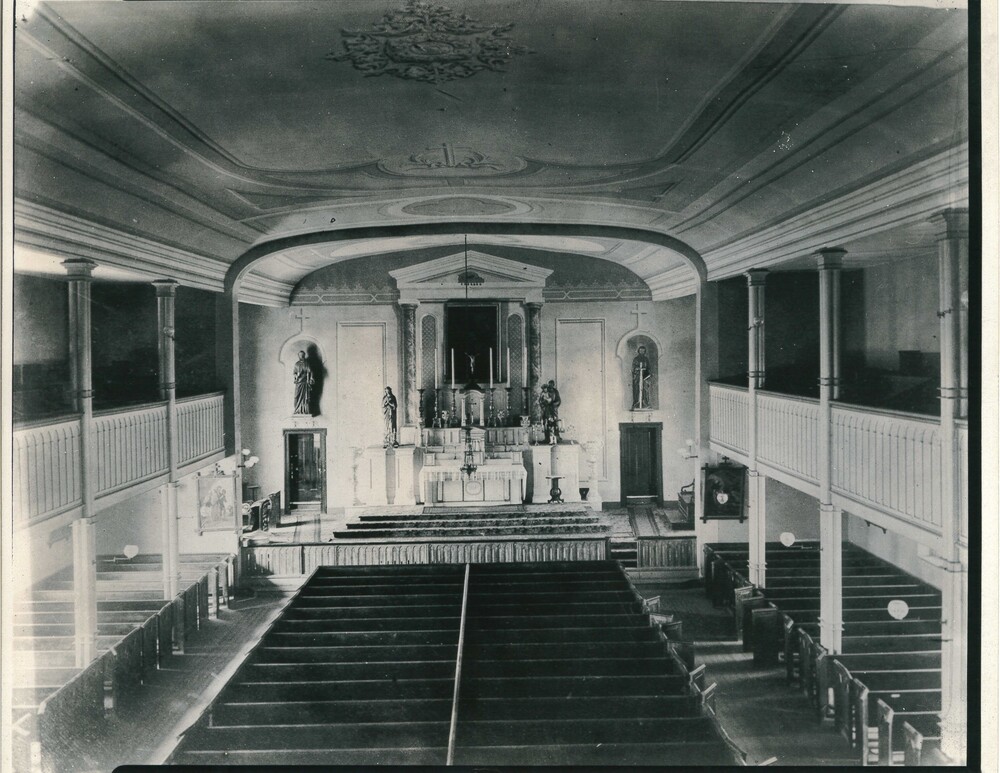
The church was a simple structure with a central bell tower. Its interior had a Greek Revival feeling, with an altar backed by a Doric pediment reredos. Its exterior featured a pebble-dash façade over brick and a shingle roof. The first Mass in the new, unheated church was celebrated on October 14, 1821. Throughout the 19th century, St. Peter’s was served by pastors who came from France (Father Lucas), Maryland, Belgium and Ireland.
In 1824, the first rectory, a two-story, four-room residence, was built next to the church on Second Street. A larger rectory replaced it in 1834. St. Peter’s added a school in 1867, at Third and E Streets SE, on land donated by Thomas Bayne, a convert and prominent lay leader who had been baptized at St. Peter’s in 1822.
Circa 1823, St. Peter’s established a cemetery in Northeast Washington, on land donated by Nicholas Young that was bounded by Fourth and Fifth and H and I Streets. In 1867, this graveyard was closed, and the deceased reinterred in Mount Olivet Cemetery.
According to notes written for the parish centennial by pastor Msgr. James O’Brien, a trapdoor near the sanctuary in the church “opened on a stairway leading down under the sanctuary and in the early days the dead of the congregation were temporarily deposited there.” Some, including the second pastor, Father Matthew Deagle, were “reinterred in the north yard of the church” before C Street was lowered and widened. They were later moved to Mount Olivet.
St. Peter’s patrimony from the first church includes the two alabaster urns and two marble pedestals still standing in the sanctuary today, as well as the wooden cross that topped the bell tower. That cross, which can be seen now in St. Peter’s vestibule, is used for veneration during Good Friday liturgies.
Also part of the legacy of the first church was the sin of racism. The balcony, or gallery, of the 1821 church was used to segregate African Americans from the rest of the congregation.