










Every civilization honors its dead. That’s why there are pyramids, catacombs, tumuli, mausoleums, cemeteries, graveyards, and columbaria around the world.
The revised Catechism of the Catholic Church explains why we bury people: “The bodies of the dead must be treated with respect and charity, in faith and hope of the Resurrection. The burial of the dead is a corporal work of mercy; it honors the children of God, who are temples of the Holy Spirit.” (#2300)
From its earliest days, St. Peter’s did this. The parish temporarily put some of its dead in a space under the sanctuary, before interment in a small graveyard on its C Street side. The first parishioner buried from St. Peter’s was Irish-born Mary Murphy on Sept. 24, 1821, three weeks before the first Mass officially christened the new church.
Several priests were buried under the sanctuary, then reinterred in the graveyard on C Street; they were Father Matthew Deagle, second pastor; Father Edward Knight, eighth pastor; and Father Charles Brennan, an assistant in the 1850s. Around 1825, parishioner Nicholas Young donated a city block in Northeast, bounded by Fourth and Fifth and H and I Streets, for use as the parish cemetery. The first person buried there, on Dec. 13, 1825, was an enslaved man named Ignatious.
In 1858, St. Peter’s joined three other parishes (St. Patrick’s, St. Dominic’s, and St. Matthew’s) to form Mount Olivet Cemetery on farmland along Bladensburg Road NE. The first St. Peter’s burial there was a child, Matilda B. Arnold. Over time, the deceased buried in the graveyard adjacent to the church were reinterred in the parish cemetery, and in 1867, when that cemetery was closed, the deceased were reinterred at Mount Olivet.
St. Peter’s will celebrate a MASS OF REMEMBRANCE for parishioners buried in Mount Olivet on Saturday, Nov. 6, 2021, at 11 a.m. in the cemetery. Immediately after the Mass, there will be a guided tour of graves with special significance for St. Peter’s; self-guided tour maps will also be available. Everyone is welcome. Click here for more information - including a map and tour information!
We pray for the dead because the church encourages it as a spiritual work of mercy. Interestingly, this Christian tradition has roots in the pagan All Hallows Eve, a Celtic holiday honoring the dead (and a precursor of Halloween).
As the Catholic faith spread to pagan lands in Europe, the church adapted the pagan holiday to honor all Christian martyrs, later expanding it to all saints. It became All Saints Day, observed on Nov. 1, by the ninth century. And, by the 13th century, the church had put Nov. 2 on its liturgical calendar as All Souls Day, a day for Christians to remember all the “faithful departed,” whether saints or sinners.
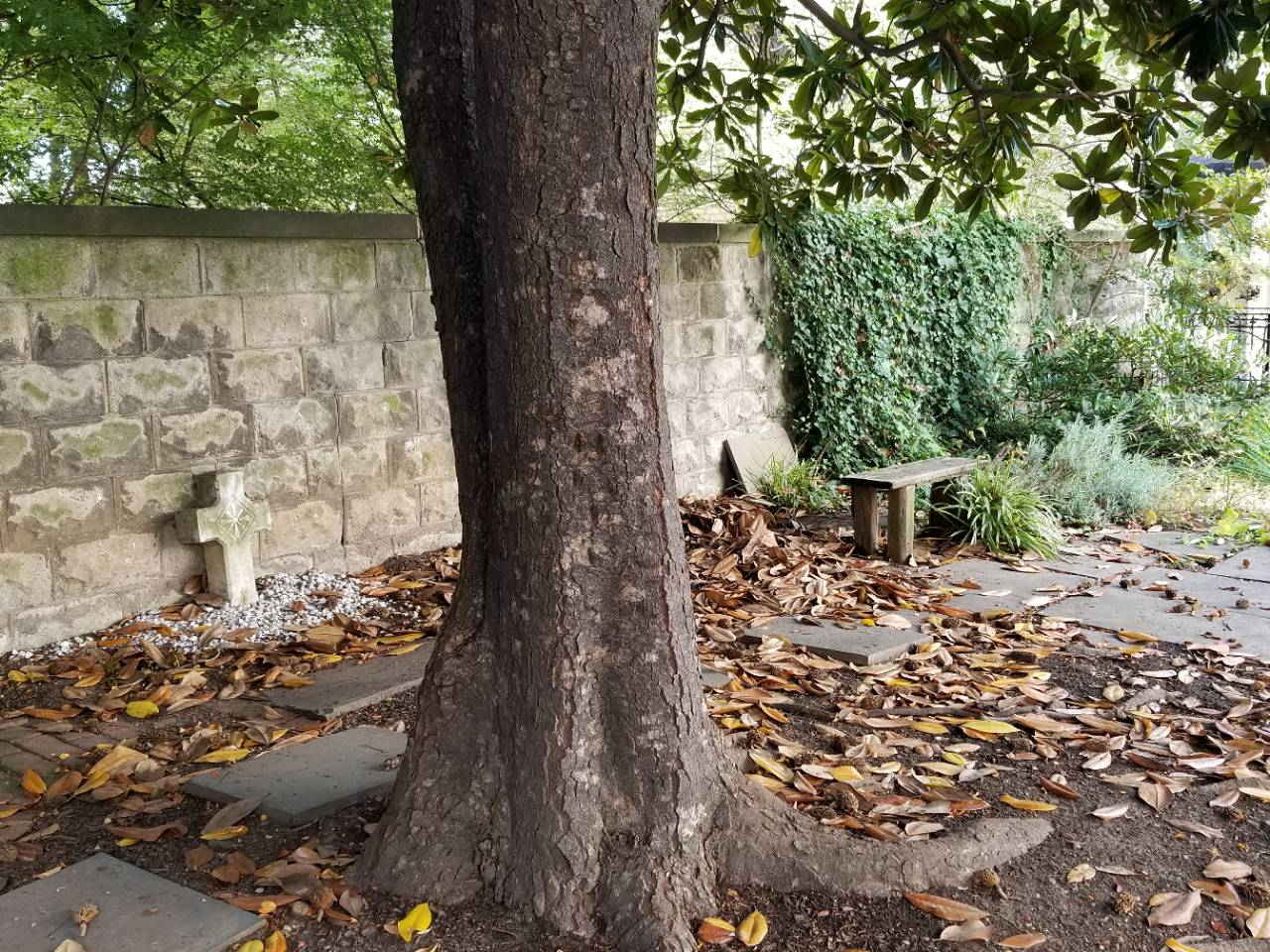
Today, the north yard of St. Peter’s along C Street is a quiet spot with a wooden bench placed in remembrance of a parishioner’s deceased child. In the 1820s, the north yard was a parish graveyard.