










Once the founders of St. Peter’s had begun building the new church, they set about finding a parish priest. They had one in mind who was well known to them, a Rev. Baxter, and they petitioned Baltimore Archbishop Ambrose Marechal to assign him as pastor. He sent them instead a 33-year-old native of France, entirely new to Washington, Father James Lucas.
In fact, the parishioners were not displeased. In a letter to Archbishop Marechal recounting his first days at St. Peter’s, Father Lucas described meeting a Mr. Matthews, who said to the young priest, “I am wholly satisfied with Msgr. the Archbishop’s choice; I feared he might send us an Irishman.” (That would come later, and be repeated often.)
James Lucas was born in 1788 in Rennes, France, where he was ordained in 1812. Three years later, he immigrated to the United States. He spent several years as a pastor in Norfolk, Va., before being assigned to the fledgling church near the Capitol. He arrived here on Sept. 3, 1821, and celebrated the first Mass on Oct. 14. He and his congregation must have been eager to get started: Father Lucas sought the archbishop’s permission to say Mass in the new church before it was officially dedicated, which finally happened on Nov. 3.
The challenges facing the young pastor were considerable. From the start, as he remarked to the archbishop, Father Lucas noticed that the members of the committee charged with fund raising “do not get on very well.” The parish’s debt was daunting, $3,400. And parish trustees were slow to provide Father Lucas with a decent wage – a situation that became so intolerable he announced in July 1824 that he was leaving and the church would be closed. That got their attention. Things quickly improved.
St. Peter’s had no rectory when Father Lucas arrived, and at times he was required to board in private homes, including with a Mr. Lowe (identified in some documents as the church’s architect) on New Jersey Avenue, and at the Diggs home at 2nd and D Streets. The first rectory was a modest dwelling, four rooms on two floors, on the church’s north side (along C Street). Father Lucas slept on a cot on the first floor.
When his time at St. Peter’s ended, in 1829, Father Lucas joined the Jesuits. Among many assignments over the years, he taught Christian doctrine, French, and Spanish at Georgetown College, and served as assistant and later pastor at Holy Trinity in Georgetown. Falling ill in late 1846, Father Lucas moved to the Jesuits’ novitiate in Frederick, Md., where he died the following year. When the novitiate closed in 1903, he was reinterred, along with 78 other Jesuits, at St. John’s Cemetery in Frederick. The Jesuits’ graves are marked by a single large headstone remembering each one by name.
We should be grateful for the faith, and courage, of Father James Lucas. He started St. Peter’s on the 200-year journey we celebrate today.
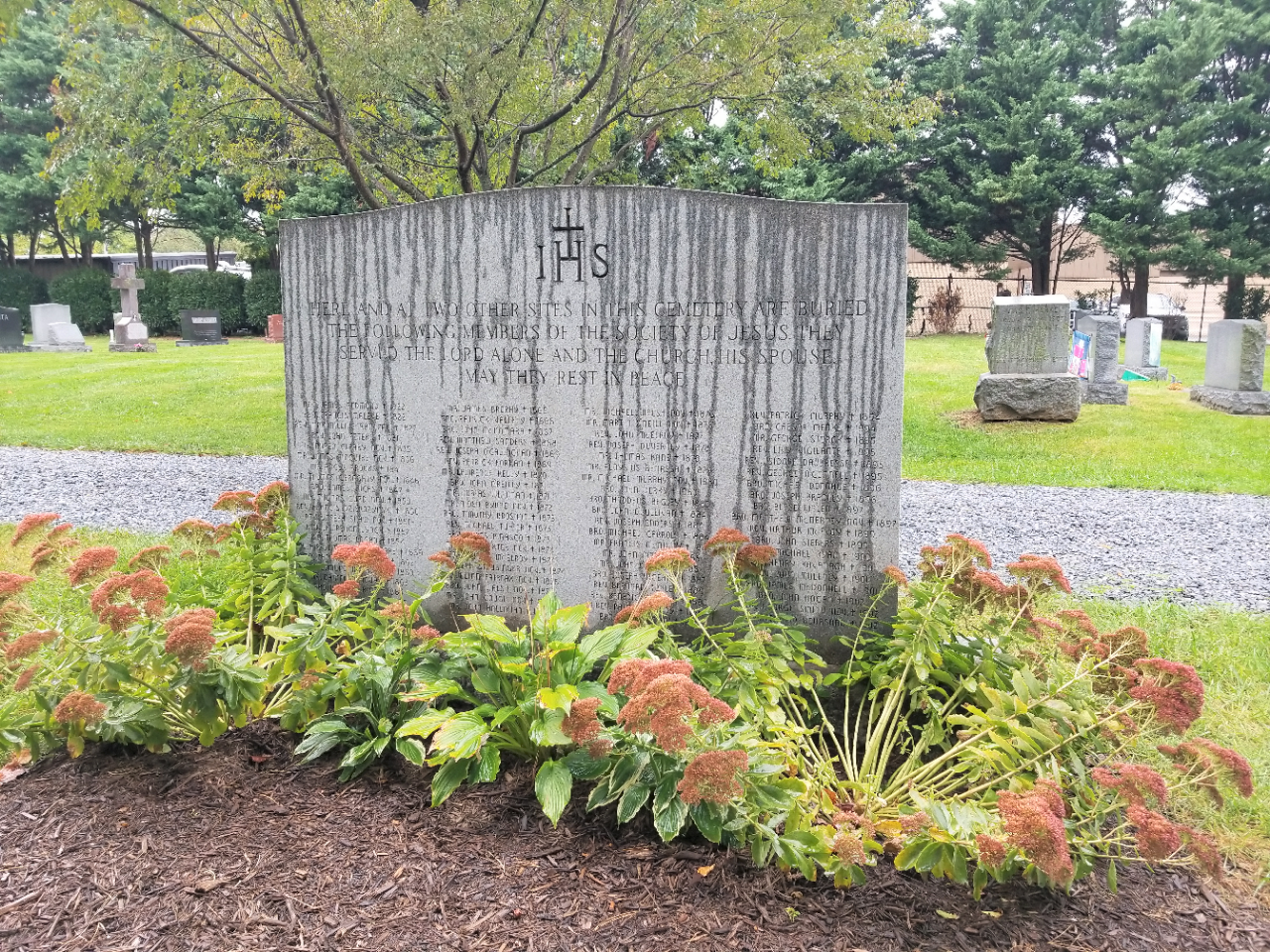
Rain runs down the face of the headstone marking the graves of Father James Lucas and 78 other Jesuits at St. John’s Cemetery, Frederick, Md.
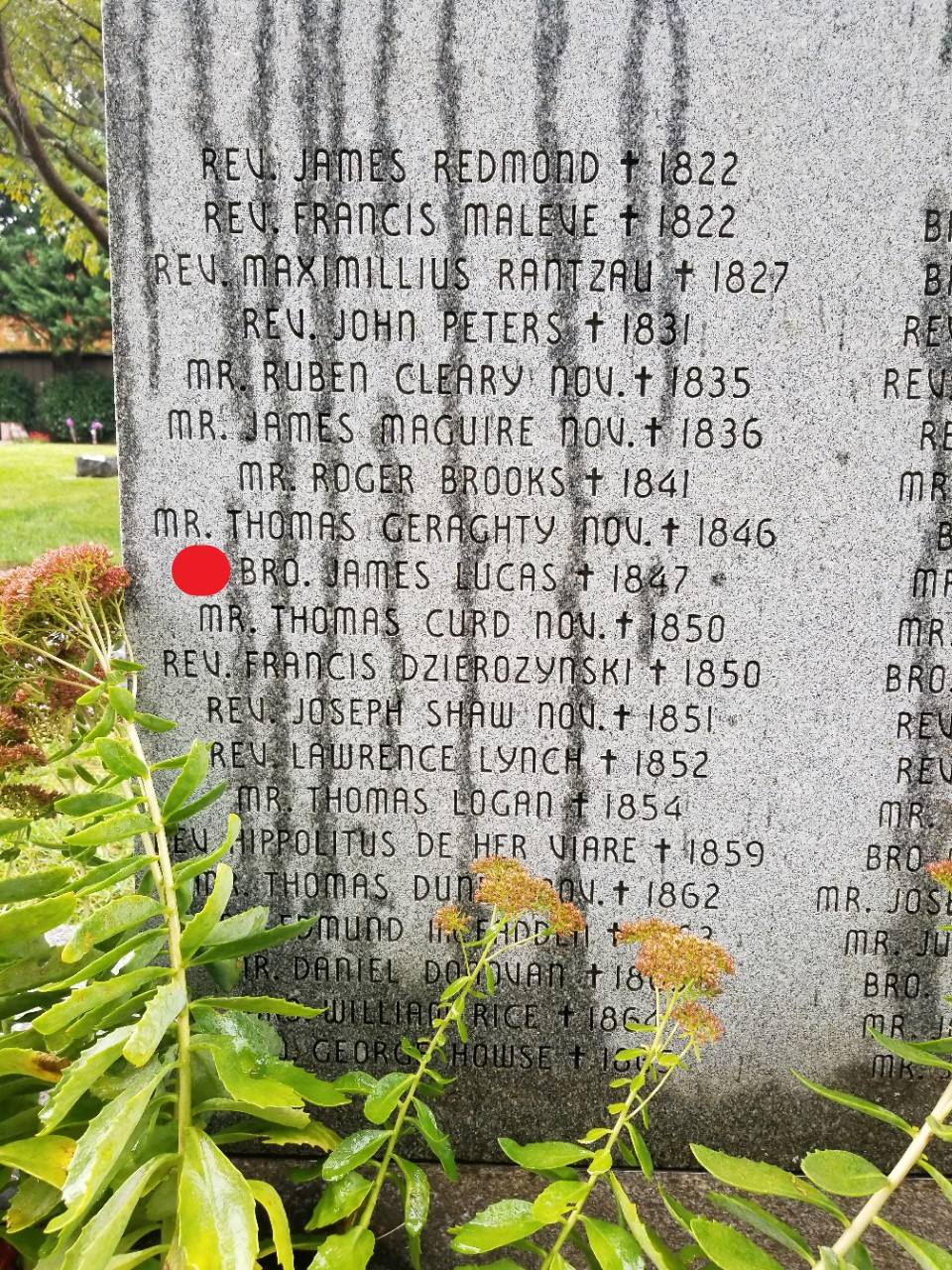
On the headstone, Father Lucas (name indicated by a red dot) is erroneously identified as Bro. James Lucas.