











The Second Church: 1890
By 1888, when Father (later Msgr.) James O’Brien became pastor of St. Peter’s, it was clear the parish had outgrown its first church. Demolition of the 1821 structure began after Easter in 1889, and Baltimore Cardinal James Gibbons presided at the laying of the cornerstone for the new church that September.
A parade from McPherson Square in Northwest Washington preceded the ceremony. According to notes written for the parish centenary, Msgr. O’Brien recalled that “at its conclusion a choir of a hundred voices sang the Alleluia Chorus accompanied by the Marine Band and directed by Mr. John P. Sousa.”
While the second church was under construction, Masses were celebrated in the school hall. By Easter of 1890, Mass was said in the basement of the new structure, and by September in the church proper. The church was dedicated then, but not consecrated until 1916, when its debt was paid off.
Built of Maryland stone, the 1890 church featured a Romanesque style with Gothic elements, including a soaring roof line. It had a spire 140 feet high and its sanctuary contained 12 windows made of fine French stained glass. It could seat 950 people. The reredos, or altarpiece, initially featured a 4-foot marble statue of St. Peter standing under a domed canopy. Later, probably early in the 20th century, that statue was removed and replaced with the Crucifixion group.
To mark its 75th anniversary in 1896, the parish installed a new Jubilee Altar and two side altars made of carrara marble with onyx pillars. The 1834 rectory was replaced in 1901 by the current residence.
In 1920, St. Peter’s marked two important anniversaries, the parish centenary and Msgr. O’Brien’s Golden Jubilee. To cap off a four-day celebration in June, parishioners contributed funds to install electricity in the rectory and church.
St. Peter’s second church weathered the First World War and the Depression, but catastrophe struck on March 27, 1940: A five-alarm fire caused by the spark from a worker’s blowtorch. Fought by 160 firemen with 40 pieces of equipment, the fire raged in the church attic, trapped between slate above and plaster below, until the roof collapsed into the sanctuary.
The patrimony from the second church includes the original exterior walls and stained-glass windows, marble altars, baptismal font, and bell tower, including the bronze bell cast in Baltimore in 1855.
The second church eliminated balconies, where African Americans had been required to sit in the first church. But the sin of racism persisted throughout the five decades of the second church, as African Americans were still segregated, now in the back pews of the church.
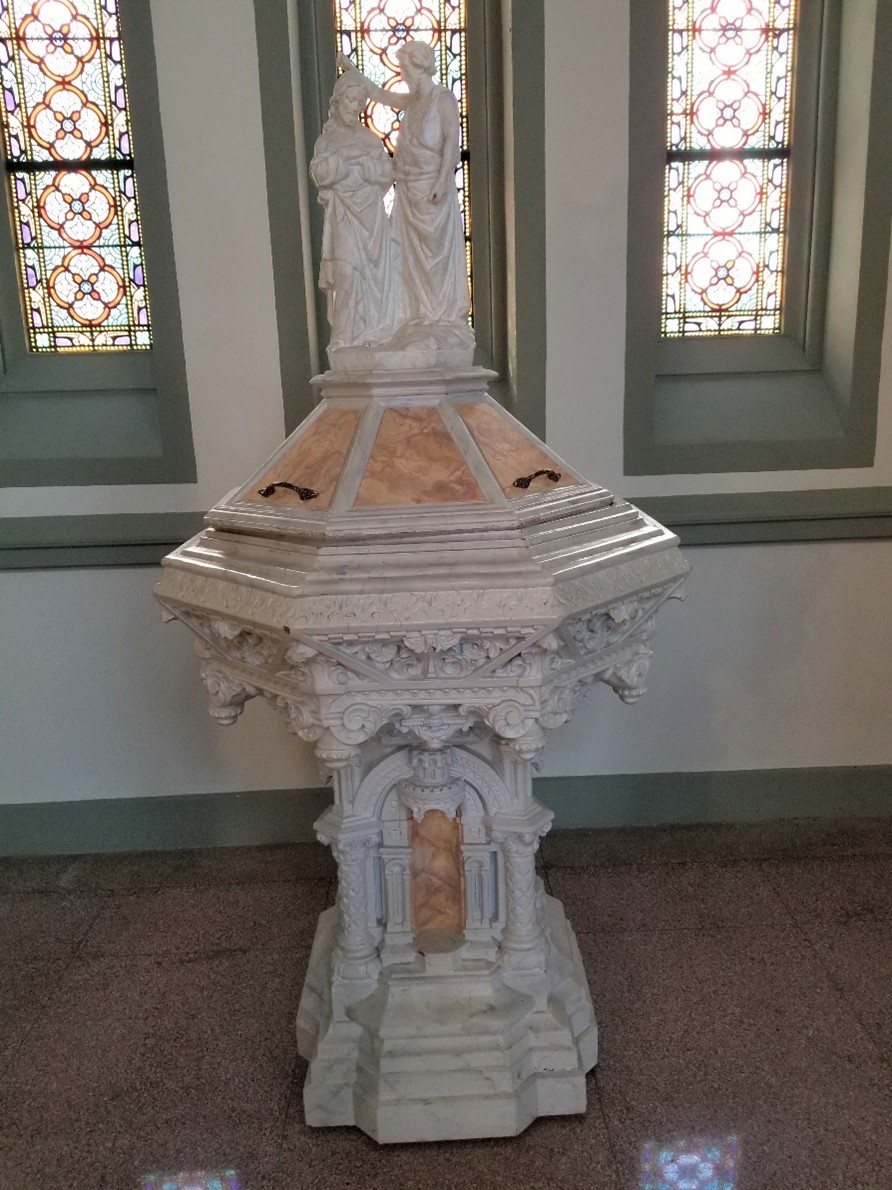
Baptismal font, seen today in the alcove to the right of the Joseph altar. It dates from the 1890 church and was restored and repainted during the 2010 Altar Furnishings Campaign. The sculpture atop the font -- showing the baptism of Jesus by John the Baptist at the Jordan River -- had broken and was recast as part of the restoration.