











St. Peter’s third church rose in record time from the ashes of the 1940 Easter-week fire that destroyed most of the second church. Easter Masses in 1941 were celebrated in the new church, rebuilt in Roman Basilica style and preserving the original exterior walls and 12 French stained-glass windows in the apses of the second church from 1890.
The Roman Basilica style has the basic elements of a central nave and side aisles separated by rows of columns and terminating in three apses; it is our church today.
Throughout its 80-plus years, the church interior has undergone several renovations. The first two occurred in the pastorate of Father Michael O’Sullivan (1970-2005), beginning after the Second Vatican Council (1962-1965), which mandated moving altars closer to the people. So, in the 1970s, front and back pews were removed, and a small wooden altar was placed nearer the congregation.
During a major renovation of church properties ending in 1986, the church’s communion rail was removed; the marble altar in front of the altarpiece was reconfigured and moved forward to replace the wooden altar; and the church interior was painted in Italian Renaissance style. The late Andre Houston, a parishioner, was the architect/designer for this work and for the installation of an elevator in 1992. That elevator was replaced this year.
The 1980s renovation is also when the crucifixion group was moved from the rear of the central apse forward, with the crucifix hung from the ceiling and the statues of Our Lady and St. John on plinths at either side. The church’s three altars, all of carrara marble with onyx pillars, are the Jubilee altars installed in 1896 for the parish’s 75th anniversary.
In 2010, wooden furniture integrating church architectural elements was commissioned for the sanctuary, and the former bronze communion-rail gates were repurposed as centerpieces for the new marble altar of repose under the tabernacle and new marble ambo; the c. 1890 wooden baptismal font also was restored then.
Earthquake damage in 2011 necessitated repairs to the roof, mortar and stone work, and marble cross atop the façade. In 2020, the church interior was painted in new colors but still in Italian Renaissance style.
The frieze inscription around the nave, in Latin and dating from 1941, is a quote from Matthew 16:18: “You are Peter, and upon this rock I will build my church and the gates of the netherworld shall not prevail against it.” In the 1980s renovation, the frieze was extended around the central apse using the words “Christ has died, Christ is risen,” taken from a memorial acclamation in the first post-Vatican II Roman Missal in English. This was changed in 2020 to another quote in Latin from Matthew 16:16: “You are the Christ, the son of the living God.”
A new pipe organ, built by the Noack Organ Company, was installed in 2019, replacing a 1941 organ that still had some pipe work from the parish’s first pipe organ c. 1840. The church’s 1890 belltower is currently being restored.
St. Peter’s patrimony includes artifacts from the first and second churches. There is also the legacy of segregating African Americans for nearly 130 of its 200 years, from the first church in 1821 until 1948, when the new Archdiocese of Washington began to integrate its churches and schools.
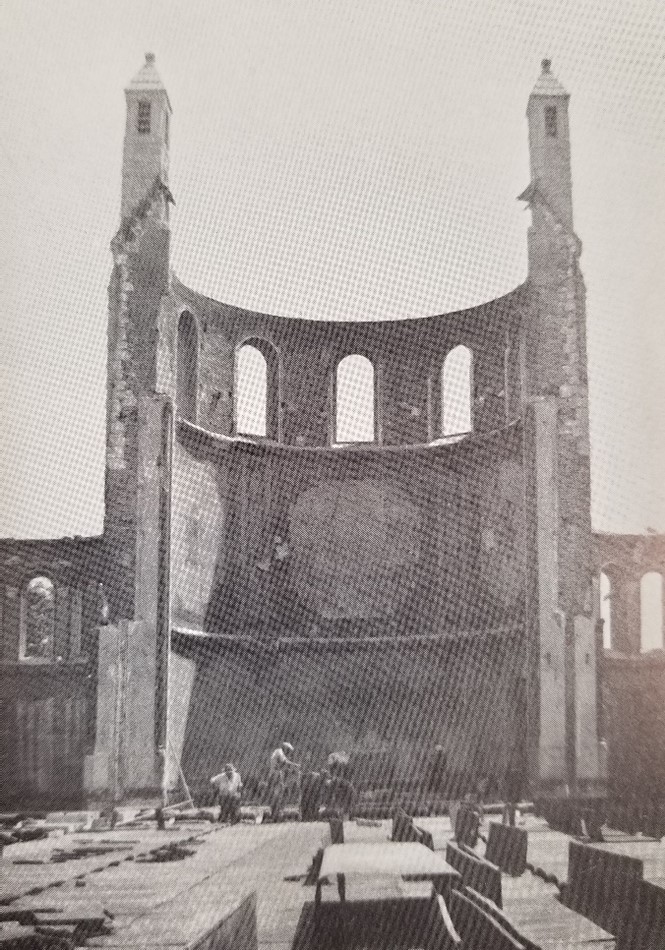
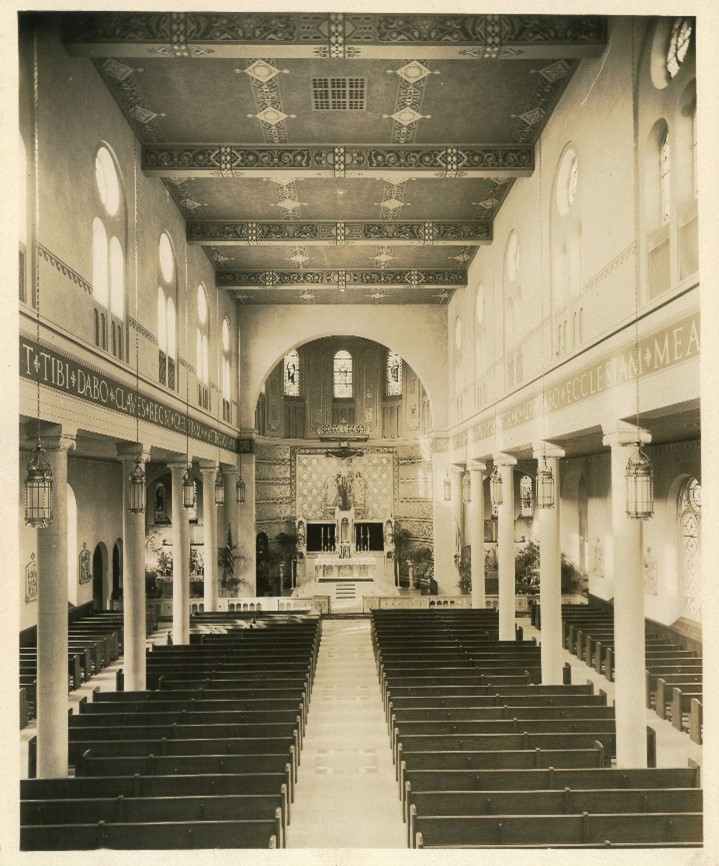
A 1940 photo, at left, shows all that remained of the 1890 church after a catastrophic fire. These exterior walls were used in the third church, completed in 1941, whose interior is seen in the undated photo at right.