










St. Peter’s on Capitol Hill opens bicentennial celebration with Mass and 200th birthday party
OCT 1, 2021 LOCAL
Clergy Who Served in the Third Church, 1941-present
(P: pastor; A: assistant)
This list was maintained for many years by Lynn Marsh Freeman, and was updated in 2021 by Jerry Conlon and Kathleen Wiegand.
Clergy Who Served in the Second Church, 1890-1940
(P: pastor; A: assistant)
This list was maintained for many years by Lynn Marsh Freeman, and was updated in 2021 by Jerry Conlon and Kathleen Wiegand.
Clergy Who Served in the First Church, 1821-1889
(P: pastor; PPT: pastor pro tem; A: assistant)
This list was maintained for many years by Lynn Marsh Freeman, and was updated in 2021 by Jerry Conlon and Kathleen Wiegand.
Last Friday, January 21, marked the 48th anniversary of the annual March for Life protesting Roe v Wade. From the beginning St. Peter’s has been there to offer hospitality to the marchers. This account of the parish’s efforts over the years is drawn from the recollections of Suzanne O’Connor and Molly Pannell, who each in her turn (along with now-deceased parishioner Margarita Smith) coordinated the work.
By any measure, providing refreshment, a bathroom, and a warm place to rest for even a fraction of the thousands who come to the March for Life constitutes an amazing logistical accomplishment. St. Peter’s does not do a head count, but other numbers, from recent years, tell the story: 4,000 cups used during the day; 200 dozen doughnuts ordered; a dozen large urns continuously brewing coffee or boiling water; 30-40 volunteers for everything from prep to cleanup.
For almost 50 years now, St. Peter’s parishioners have offered hospitality to marchers who come to Washington each January to protest “Roe v Wade.” Mike and Barbara Eck, who have been members of the parish since 1972, helped with our earliest efforts. Here are some of Mike’s reminiscences:
The March for Life was founded by a St. Peter’s parishioner, Nellie Gray. Nellie was on the parish council when the Supreme Court decision in Roe v Wade was announced on January 22, 1973. She was appalled, and decided to organize a protest march to be held on the first anniversary of the decision. At the time, Nellie was a retired government lawyer. She resigned from the parish council and her other pursuits and dedicated the rest of her life to “saving the babies.“ She assembled a committee from a network of pro-life advocates who planned much of that first march from her home on Sixth Street SE.
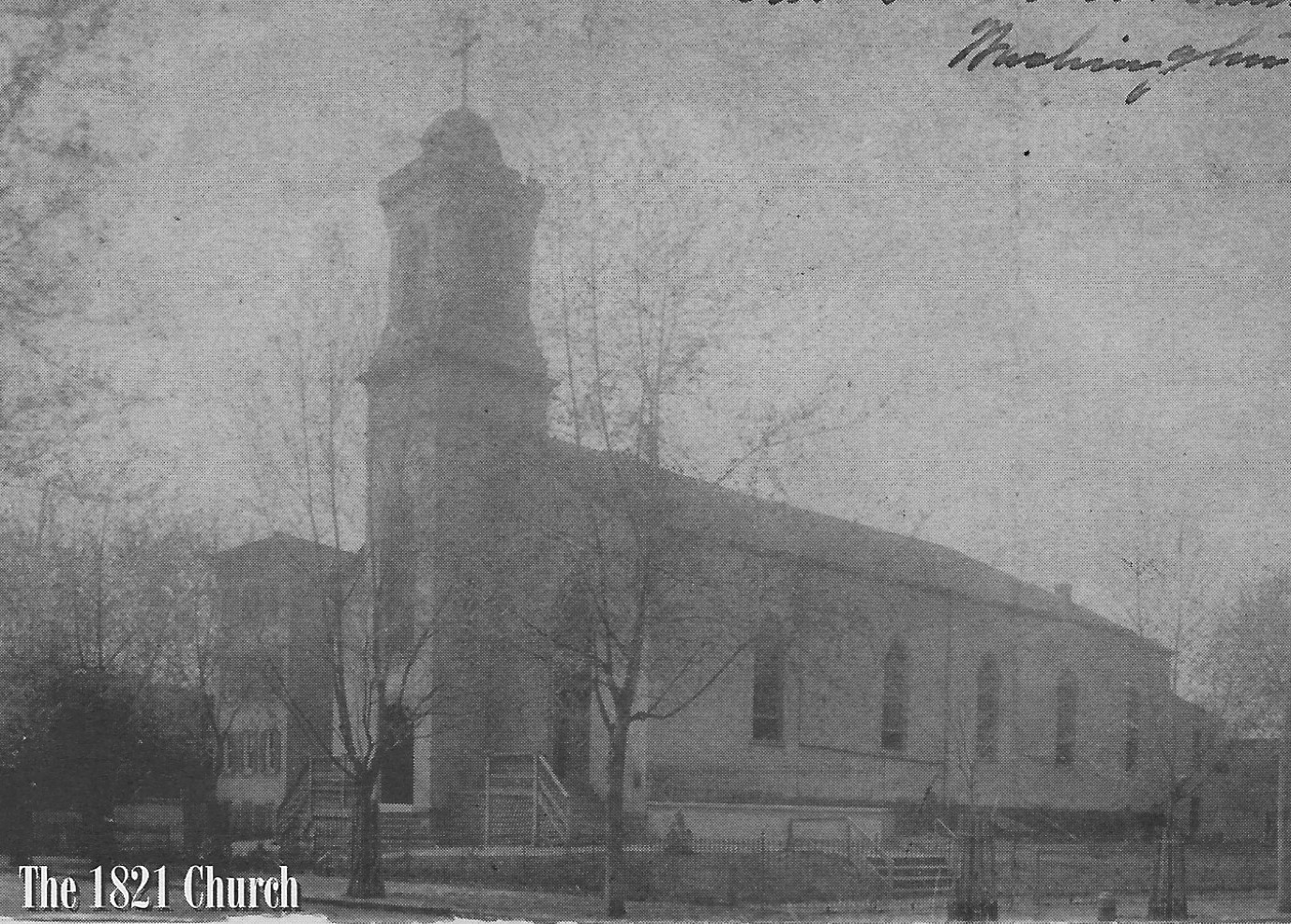
Daniel Carroll of Duddington, the landowner whose estate included most of what is now Capitol Hill, donated the land on which St. Peter’s Church was built in 1821. He also chaired the Subscription Committee formed a year earlier to raise money for the new parish near the Capitol.
The side altar on the left is dedicated to Mary, Queen of the Universe. Her statue stands on the tabernacle. Like the altars to its right, the Mary altar is made of carrara marble with onyx pillars. These Jubilee altars date from 1896, when the parish marked its 75th anniversary. Above the altar are three French stained-glass windows dating from the second church in 1890. They survived the 1940 fire.
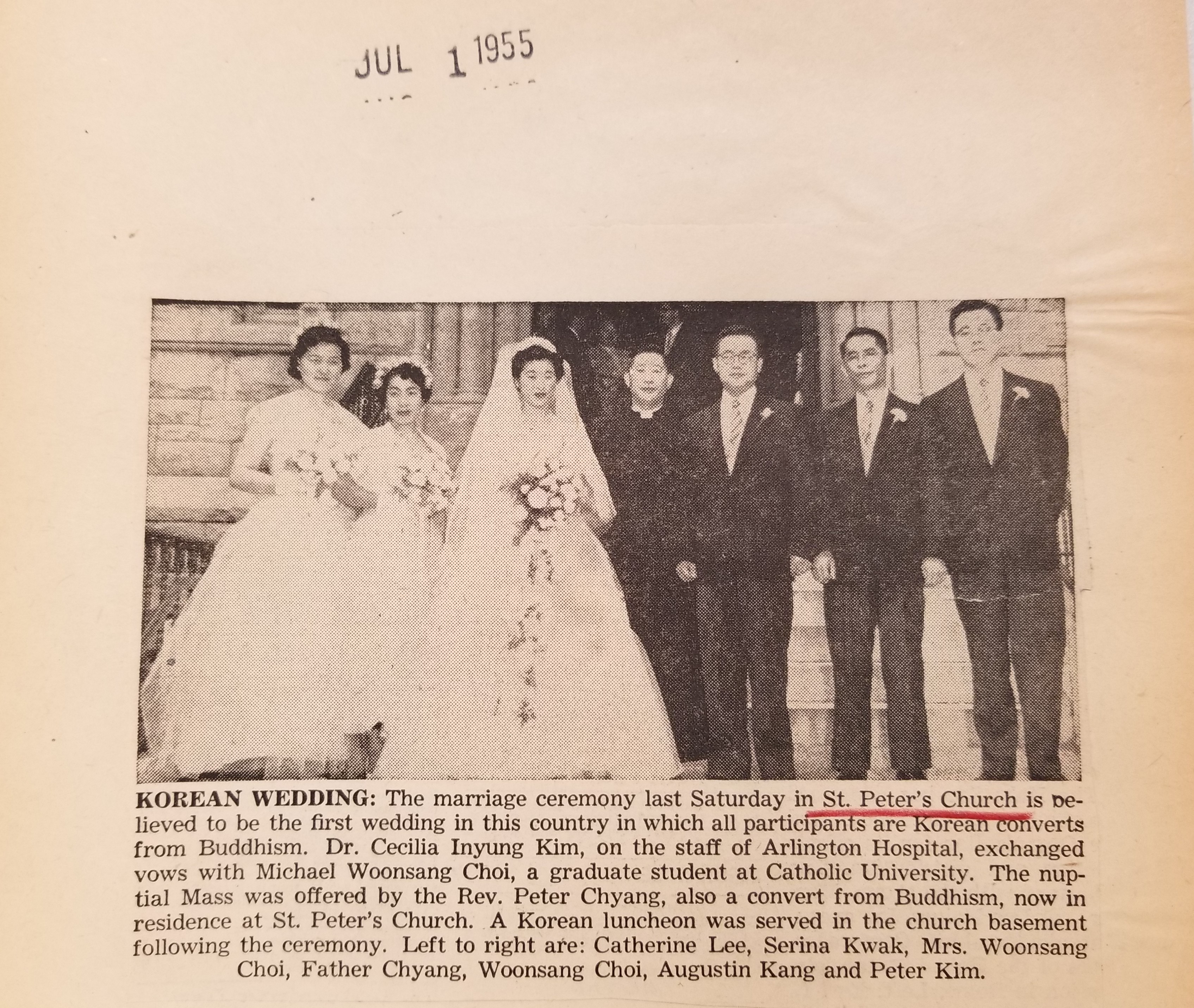
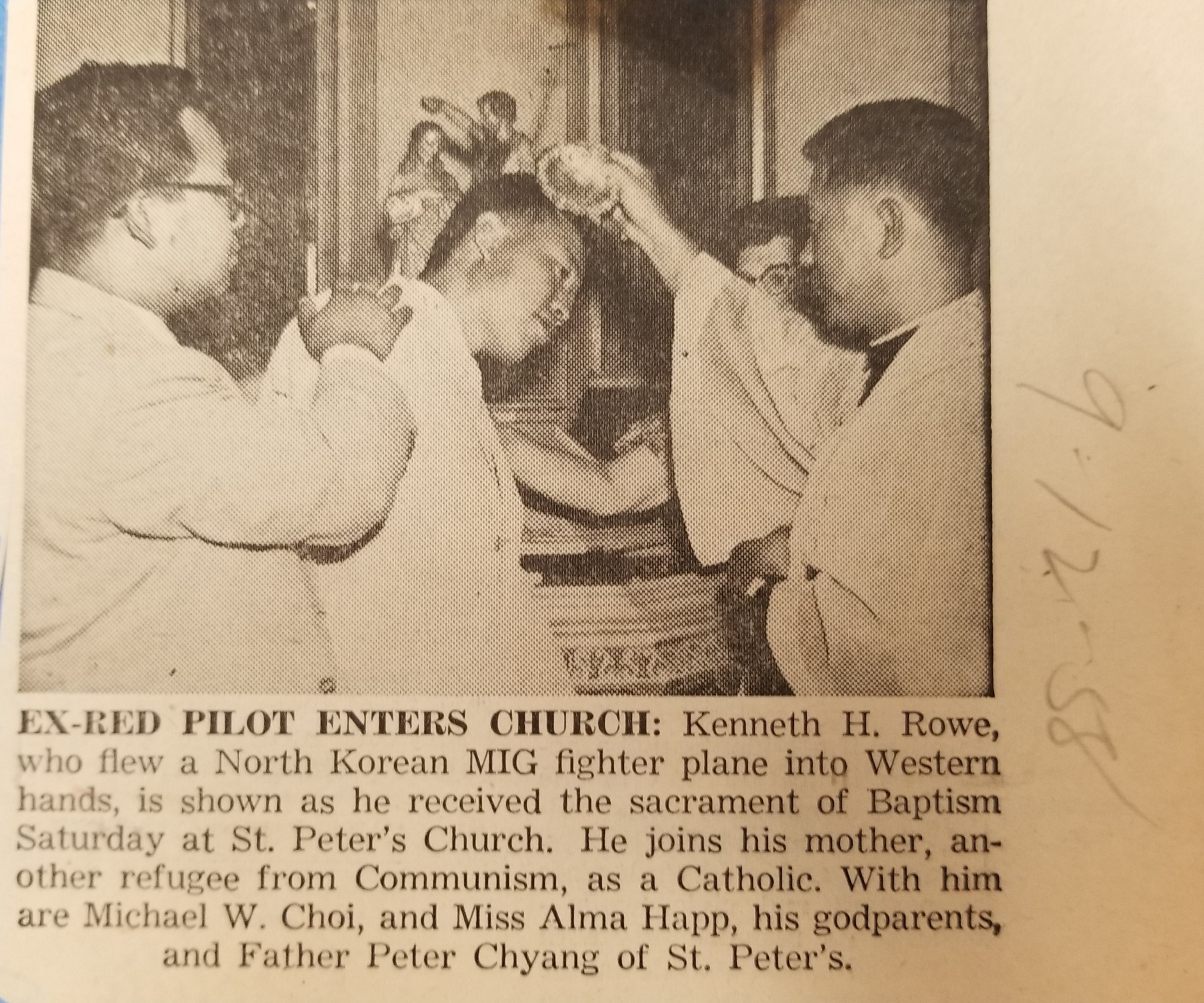
From the Catholic Standard Archives, 1955 and 1958 (reprinted with permission)
Korean Connection: While Father Peter B. Chyang served as an assistant at St. Peter’s from 1954 to 1960, he presided at two news-making ceremonies: the wedding of Korean Buddhist converts in 1955 and the 1958 baptism of a North Korean MIG fighter pilot who defected.
From St. Peter’s 150th Anniversary booklet, published in October 1971:
“A five-alarm five destroyed St. Peter’s on March 27, 1940, three days after Easter. The first alarm was turned in at 10:13 a.m., and there was a general alarm calling all off-duty firemen to the scene at 10:50.
The Second Church: 1890
By 1888, when Father (later Msgr.) James O’Brien became pastor of St. Peter’s, it was clear the parish had outgrown its first church. Demolition of the 1821 structure began after Easter in 1889, and Baltimore Cardinal James Gibbons presided at the laying of the cornerstone for the new church that September.
More than 40 years ago, several parishioners -– most the mothers of young children -- established the St. Nicholas Club to provide Christmas gifts to neighbors who would otherwise go without. Over the years, this ministry has provided literally tens of thousands of gifts for people of all ages, from newborn infants to elders and every age between.
Please click here for a photo album from our recent Mass of Remembrance and tour at Mt. Olivet Cemetery.
Once the founders of St. Peter’s had begun building the new church, they set about finding a parish priest. They had one in mind who was well known to them, a Rev. Baxter, and they petitioned Baltimore Archbishop Ambrose Marechal to assign him as pastor. He sent them instead a 33-year-old native of France, entirely new to Washington, Father James Lucas.
The Cemeteries of St. Peter’s Parish:
A Brief History by Jerry Conlon
Mt. Olivet Cemetery was chartered by Act of the United States Congress. The cemetery was established and governed by St. Peter’s Parish along with St. Patrick’s, St. Dominic’s, and St. Matthew’s. The first burial from St. Peter’s was a young child, Matilda B. Arnold, in March 1858. The original cemetery covered 40 acres purchased from the Fenwick family’s farm along Bladensburg Road. The land area was added to over the years until it reached its present boundaries. The cemetery no longer has lots for sale. However, from time to time, the owners of existing lots sell them to others. The cemetery has an established columbarium and the cemetery currently offers niche space for sale.
THE JOSEPH APSE
The side altar on the right of the church is dedicated to St. Joseph, spouse of Mary, the mother of Jesus. His statue stands atop the tabernacle. Like the altars to its left, the Joseph altar is made of carrara marble with onyx pillars. These Jubilee altars date from 1896, when they were installed during the parish’s 75th anniversary.
Every civilization honors its dead. That’s why there are pyramids, catacombs, tumuli, mausoleums, cemeteries, graveyards, and columbaria around the world.
The revised Catechism of the Catholic Church explains why we bury people: “The bodies of the dead must be treated with respect and charity, in faith and hope of the Resurrection. The burial of the dead is a corporal work of mercy; it honors the children of God, who are temples of the Holy Spirit.” (#2300)
From its earliest days, St. Peter’s did this. The parish temporarily put some of its dead in a space under the sanctuary, before interment in a small graveyard on its C Street side. The first parishioner buried from St. Peter’s was Irish-born Mary Murphy on Sept. 24, 1821, three weeks before the first Mass officially christened the new church.
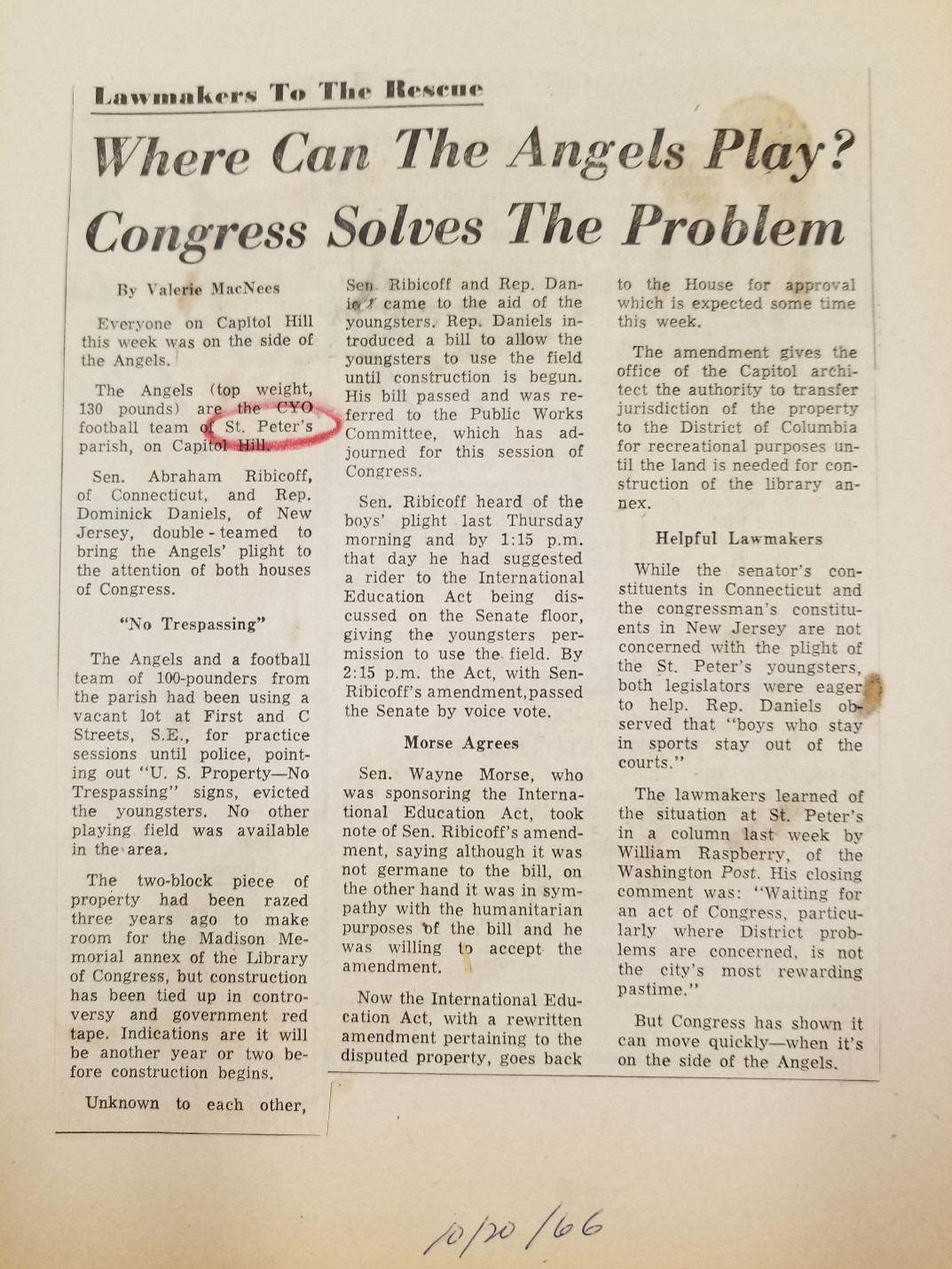
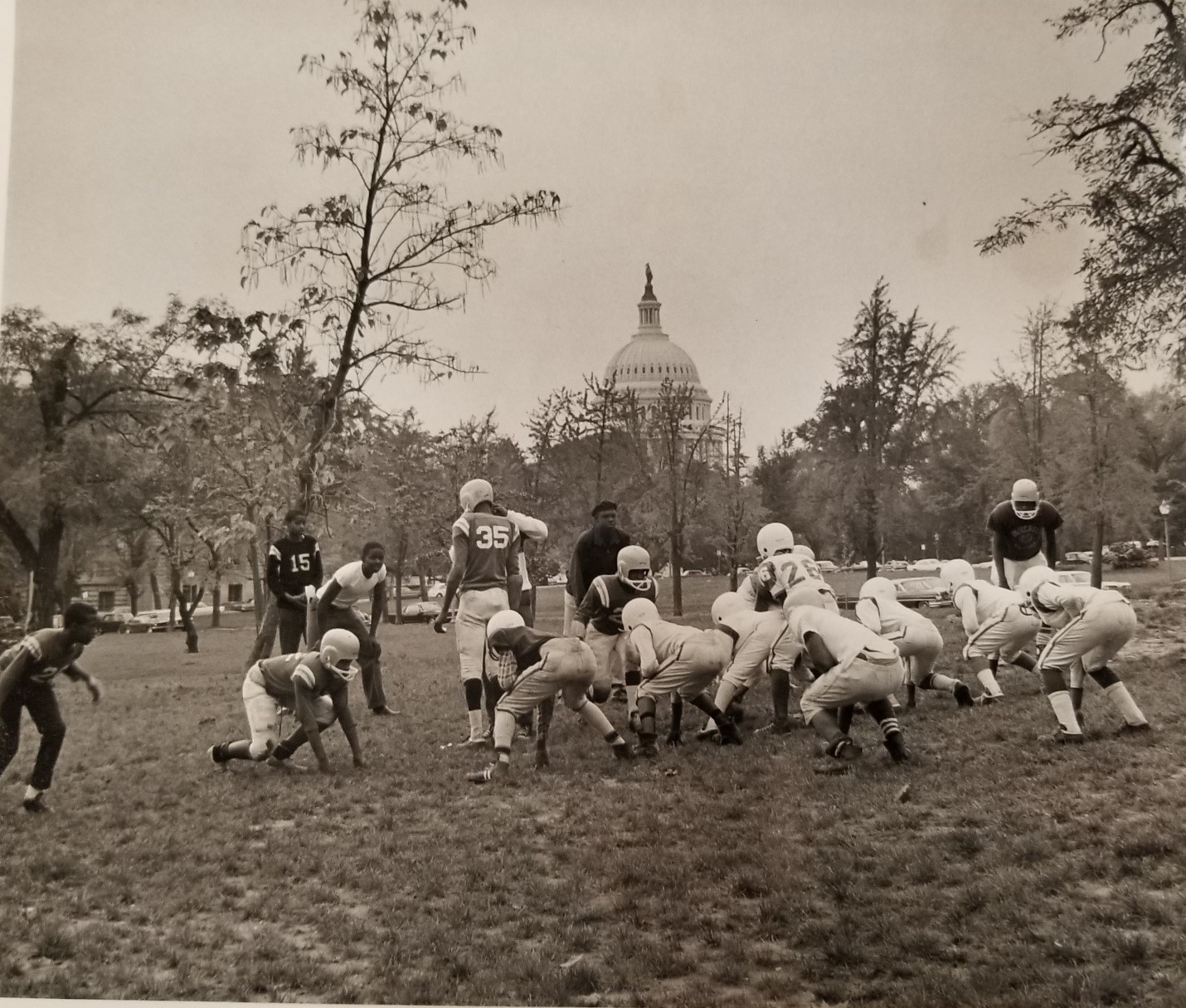
ANGELS SPREAD THEIR WINGS: St. Peter’s “Angels,” the parish CYO football team, again is using the vacant lot near the Capitol as a practice field. Led by Sen. Abraham Ribicoff and Rep. Dominick Daniels, both houses of Congress, in the closing hours of the 89th session, turned their attention to the team’s plight and added a rider to the International Education Act allowing the vacant lot to be used by the District of Columbia for recreation purposes until the Library of Congress annex is built on the property.
You are Peter, and upon this rock I will build my church, and the gates of the netherworld will not prevail against it. I will give you the keys to the kingdom of heaven. (Matthew 16:18-19, inscribed in Latin on the frieze inside St. Peter’s Church)
We do not know how our parish came to be named for St. Peter. But he is an apt patron of the first Catholic church on Capitol Hill – the first one called to be a disciple of Jesus, the first among the apostles, the first pope. As he was the “rock” on which Christ built his church, so he has been, for 200 years, the spiritual foundation of our beloved St. Peter’s Church.
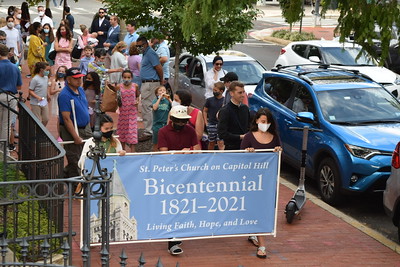
Parishioners of St. Peter’s on Capitol Hill line up behind a bicentennial banner to walk from the church to nearby Providence Park for a rally and birthday party following a Sept. 25, 2021 Mass that opened the parish’s 200th anniversary celebration. (photo courtesy of James Grimaldi)
St. Peter’s Parish on Capitol Hill began a yearlong bicentennial celebration on Sept. 25 with a late afternoon Mass, followed by an outdoor 200th birthday party in nearby Providence Park.
The opening Mass drew about 300 parishioners and friends, the biggest crowd in the church since before the pandemic, and many of them walked to the park afterward for games and music, cupcakes and ice cream, and the camaraderie that has been sorely missed for the past 18 months.
Let the Bicentennial begin!
On September 25th St. Peter’s embarks on a year-long celebration of its two centuries on Capitol Hill, a year filled with prayer, remembrance, encounters with our long history … and, not least, parties and fun activities for young and old. Here’s a sampling of things to look forward to:
No doubt that list will change and grow as the year goes on. Watch this space for more information, as well as the occasional look back at our history over two centuries.
Happy 200th birthday, St. Peter’s!